Case study
jobcrawl: an autonomous job-search pipeline
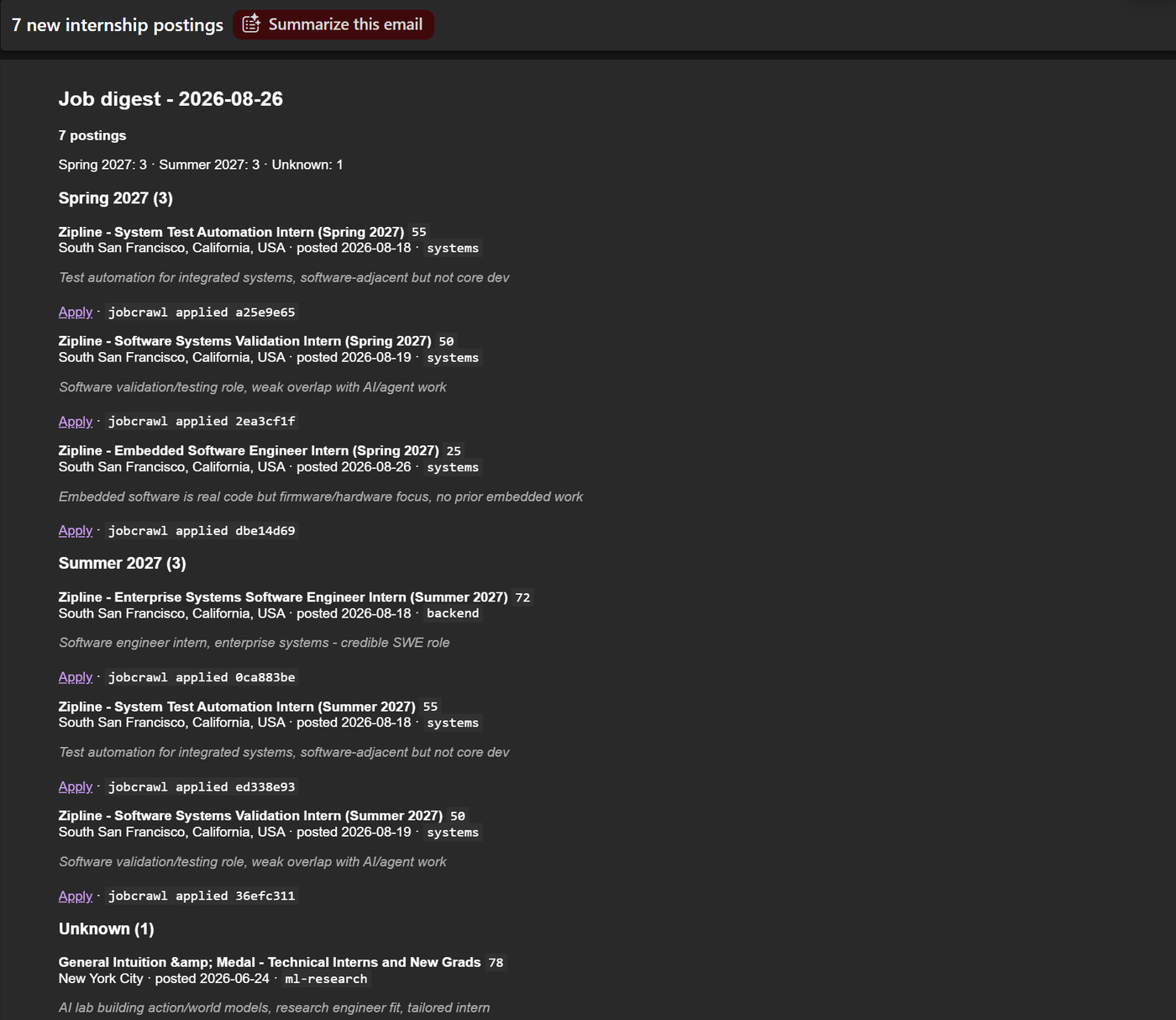
Public internship lists update slowly and miss postings that close in days. jobcrawl skips the middleman: it polls about 540 company career boards directly at the ATS source every 10 minutes, around the clock, scores anything new against a written profile of what I'm looking for using Claude, and delivers matches as email digests plus an auto-generated tracker. It has run unattended on a small EC2 instance for months. The source is private since the profile and scoring data are personal, but the architecture is the interesting part anyway.
Fetching without getting rate-limited
The hardest constraint is invisible failure. Workday boards need up to 20 POST requests each across roughly 200 boards, and an unthrottled crawler draws HTTP 429s - but a rate-limited board looks exactly like an empty board, so every 429 silently costs coverage rather than raising an error. All HTTP goes through one client that allows a single in-flight request per host with a minimum gap between requests, retries 429s and 5xxs with backoff, and never retries 404s, because a dead board needs to reach the health tracker immediately. ETags make most polls nearly free: a 304 means the board is alive but unchanged, which is treated as "contents frozen", never as "board empty".
A posting has two identities
Postings get deduplicated by a content hash of company, title, and location - but ATS URLs for the same job appear in many shapes (direct links, search pages with the job id in a query parameter, locale prefixes, tracking suffixes), so each posting also carries a normalized URL identity built from the host plus the long digit runs that are the ATS job ids. The two identities catch different failure modes: a known URL with a changed title is the same posting renamed, while a known title with a genuinely new URL is a repost - a fresh requisition that resurfaces the stored row and gets re-judged with current data instead of trusting a stale score.
Score once, then learn from feedback
A posting is scored exactly once; dedupe makes threshold or profile changes powerless over history, and a separate re-scoring pass exists for when the profile changes. The judgment loop closes through me: when I mark postings applied or skipped, those decisions are injected into future scoring prompts as calibration examples. Only postings I actually saw count - machine suppressions never masquerade as human judgment, which keeps the feedback signal clean.
Closure without a "closed" signal
Career boards never announce that a posting closed; it just stops appearing. Closure is therefore absence-based and deliberately conservative: only sources whose responses are complete and unpaginated may close a posting, only after several consecutive fresh fetches missed it, and errors, 304s, and empty responses freeze the countdown instead of advancing it. Applied postings are never auto-closed.
Cost profile
Everything except scoring is free: board APIs and feed fetches cost nothing, and the regex prefilter exists precisely to keep obviously irrelevant postings away from the LLM. The result is a system that watches half a thousand boards around the clock for roughly the price of scoring only the plausible candidates.